
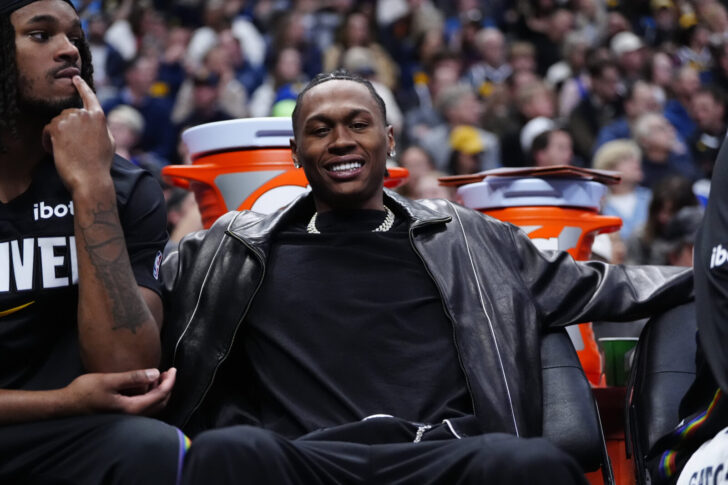
According to Shams Charania with ESPN, the Denver Nuggets are executing a sign and trade of Peyton Watson with the Cleveland Cavaliers.
BREAKING: Cleveland, Denver and the Clippers have agreed on a trade sending Peyton Watson to the Cavaliers, Max Strus to LA, and an unprotected 2031 Cavs first-round pick and a 2032 Kings second-rounder to the Nuggets, sources tell ESPN.
— Shams Charania (@ShamsCharania) August 19, 2026
Watson will sign a new four-year, $88… pic.twitter.com/hXqL3JvsU4
The Nuggets reported return for Watson is the Cleveland Cavaliers unprotected 2031 first round pick and the Sacramento Kings 3032 second round pick.
…
…
And that’s it.
We’ll call it…underwhelming. To say the least. After a Summer of constant back and forth, where Denver’s stated required return was originally multiple first round picks and pick swaps, then an impact/high level player and a first round pick, the Nuggets ultimately settle on one first round pick and one second round pick, neither of which will be realized this decade or before Nikola Jokic turns 36. Meanwhile Watson will sign a 4 year, $22 million deal with Cleveland, which at a year less in total length and $3 million less in average annual value than Christian Braun, the Nuggets fifth starter and the player his value seemed to be benchmarked against the most during negotiations, it feels pretty darn close to market value given Watson likely slots into the 6th man role if he stays in Denver.
Why Watson walks
The chances of Peyton not being a member of Denver’s roster for the ’26/’27 season have been on an upward trajectory ever since this time last year when Denver declined to offer him an extension. As reported by Bennet Durando of the Denver Post, Watson said regarding the lack of an offer “as a business, you’ve got to operate (based on) what’s best for your business, and when it comes time for me to make my decision next summer I’ve got to operate as a business myself.” Watson backed that quote up by putting together the best season of his career before losing some momentum when a hamstring injury prematurely ended his season. That left his exact value on the free agent market unclear but a significant raise was unquestioned.
The Nuggets were rumored to start negotiations at closer to the $15 million average annual value range and on the other end of the spectrum some outlandishly high numbers, like around $30 million AAV, were thrown out as possible ceilings for Watson’s salary. Naturally, Peyton ended up landing right in the middle of that range at $22 million. Even at the discounted rate the Nuggets allegedly offered initially, retaining Watson without a follow up move was going to have some serious tax penalty implications, something the Nuggets have historically shied away from. The current cap penalties the NBA has are extremely restrictive once you start exceeding the tax aprons, and Watson’s salary would have in actuality cost Kroenke Sports Enterprises far more than what Peyton himself will be paid.
As the offseason progressed a split due to Denver’s unwillingness to dive deep into the tax purse seemed more and more likely. At the open of free agency there was potential for them to offload salary in order to free space to retain Watson, but as the days became weeks and cap space around the league got allocated to other offseason acquisitions the Nuggets salary dumping tactics became ever more arduous. Then the rumors about how far apart Denver and Watson were on salary started. The idea of him playing out the season on his qualifying offer to become an unrestricted free agent next summer was bandied about. Meanwhile the free agency pool thinned and he became the top player still available on the market. By the time July turned to August a Watson return to Denver seemed pretty much dead. The Nuggets extremely (self imposed) limited financial flexibility boxed them into a corner and Watson, true to his word, operated as a business himself and took, I am assuming, the most money he was offered. …Payback’s a bitch.
Where Denver goes next
Since Watson was a restricted free agent he was not counting against Denver’s guaranteed roster count which still sits at thirteen. Additionally, they’ve given Lonnie Walker IV an Exhibit 10 training camp contract that seems more likely to be converted to a fully guaranteed deal than your typical training camp invite given Walker’s history as a wing scorer and the suddenly open role on Denver’s bench for exactly that. The Nuggets have now lost the two best scoring threats on their bench last season in Watson and Tim Hardaway Jr. which equates to 28 points a game. How they replace that remains to be seen but it would appear they have three options to fill two slots in their rotation.
The first, easiest and therefore, in my opinion, the most likely option is to fill these slots internally. Julian Strawther is entering his fourth season in the NBA and has shown promise as a shooter off the bench. He feels like the most natural fit to slide into Hardaway’s role but the question of consistency (and, ya know, if Denver’s going to offer him an extension or let him walk as an RFA next Summer) is yet to be proven invalid when it comes to Julian. Rolling into the next season of Jokic’s prime just hoping your sixth man will put it all together is risky to say the least. Walker is also an internal option if he really shines in the preseason. With just an exhibit 10 deal though it’s a pretty strong indication Denver’s not putting many eggs in his basket, at least right now.
The second option for Denver is to look externally. Even if they convert Walker to a fully guaranteed deal they’ll still have one roster slot open. According to Chris Haynes, the Nuggets are pursuing DeMar DeRozan.
The Denver Nuggets are pivoting and have their eyes directed on six-time All-Star DeMar DeRozan who remains a free agent in demand for contenders, league sources tell me.
— Chris Haynes (@ChrisBHaynes) August 20, 2026
DeRozan offers name recognition and certainly still has some scoring punch coming off a year in Sacramento where he averaged over eighteen points a game. However, he just turned thirty-seven years old and is clearly on the backside of his career. He also averaged those eighteen points on a bad Kings team that was perfectly fine letting DeMar cook as the ball dominant, mid-range guard he’s always been. In Denver that role will be lessened and his inability to space the floor puts added pressure on the likes of a wing like Strawther to keep defenses honest. Furthermore, recent rumors indicate that DeRozan may be looking for more than the veteran minimum, a value the Nuggets currently cannot exceed in a free agent offer.
The third option is a philosophy change with the bench. Strawther seems like a lock to be one of the regulars on the wings this season, but Denver could look more defensively focused to fill out the rest of the perimeter. It’s certainly not out of the realm of possibility that coach David Adelman turns to newly signed defensive ace Alpha Diallo on the wings. While not what you’d call a sharpshooter, he certainly can be a league average shooter from outside and if the Nuggets are able to bring more ball pressure and defense from their bench then perhaps they’d prefer that approach. Watson’s defense will also be sorely missed and while Diallo is not going to be the shot blocker that Peyton was, he can at least give Denver the ability to defend the wings that they likely won’t get with Derozan or Walker.
A gut punch after a frustrating Summer
Losing Watson is tough to swallow, there’s no way around that. Regardless of where one falls on their opinion of whether $22 million a season (and the much larger tax penalties) is worth it for Watson, the immediate return of a first and second round draft pick years in the future doesn’t inspire much hope in Denver’s immediate prospects to get a second ring with Jokic. Nor does it inspire a lot of belief that the organization truly prioritizes winning another championship with the greatest player in franchise history. Certainly those draft picks can help the Nuggets make further moves to improve the roster but the more likely scenario, at this moment at least, feels like those picks will just be used to offload more salary and further reduce the Nuggets tax penalties.
Frankly, you’re not selling that to any fanbase. Jokic’s prime dwindles with every passing day and the Nuggets are, as currently constructed, less proven and looking less talented than the team that fell disappointingly short in the first round of the playoffs last year. Denver continues to slide in the opposite direction and the best explanation that can be offered is it’s fiscally irresponsible to pay the amount of luxury tax retaining a player Denver developed over four seasons would require and that the Nuggets need to replace the draft capital they have squandered away (subtle reminder that they traded a 1st round pick to draft Watson in the first place). Perhaps Denver will prove the doubters wrong by finding players who can provide Watson and Hardaway’s level of production for less than the $28 million those players will now cost, but in the middle of August 2026…the 5 year outlook for this team is bleaker than it has been for a decade. At least the Nuggets will pay less tax though.